05/05/2025
Are indoor CO₂ levels really a problem? Yes!
It turns out that it’s actually quite a common problem, and elevated CO₂ levels can lead to fatigue, sleepiness, and headaches.
The indoor CO₂ levels I had in my home – and that many people still have in theirs – are honestly kind of shocking. Many of us (myself included) were or are struggling, e.g., at work. We are tired, we start hating our work-from-home jobs, feel exhausted, sleepy. Some of us might also have headaches.
We try to address the issue: start taking different vitamins and supplements, drink coffee after coffee, get medical screenings, try to exercise. (Don’t get me wrong: supplements, vitamins, and exercise might work and be beneficial!)
However, when I (and some of my friends) discovered the main reason… we reacted with a classic face-palm.

It was the evaluated indoor CO₂ level…
Before that realization, though, I bought a CO₂ meter. The reason? My girlfriend got pregnant and wanted to make sure that the air in the house we live in is okay.
The first thing I measured was the air in the “office room.” It’s a small room (2 m x 4 m). I used to keep the window closed most of the time. During some work calls, I would close the door as well.
Conclusions? CO₂ accumulates really quickly!
What I mean by that is: 45 minutes was enough to exceed 1000 ppm!
And it makes sense when you look at the data.
Air outside has about 425 ppm of CO₂ (0.04%) as of 2025.
The air we breathe out has 30,000 ppm of CO₂ (3%).
Obviously, when the window and door are closed, CO₂ adds up quickly.
Then I tested our bedroom during the night.
In the evening, we had 900 ppm. I knew the window needed to be opened. Ideally, I wanted to keep it under 600 ppm during the night.
The challenge was to also maintain the air temperature above a certain threshold. Having the window wide open could result in a temperature drop, so I had to figure out the balance.
Anyway, during the winter, our window was closed. No doubt we were exceeding 1000–1400 ppm.
CO₂ Chess Game
A week later, I had a chess league match in Bristol, UK. We had an away match. The room we played in was relatively small. Ten players, plus one captain in the room. Windows closed, the doors were closed as well, as next to us there were players as well. It was a classical time format, so we stayed in that room for four hours in total. The CO₂ was crazy high. I didn’t take my CO₂ meter with me! But I’m telling you, the air was crazy bad.
The funny thing is that after a long, drawish game, I made a few inaccurate moves. My opponent gained an advantage. He was a gentleman about 60 years old, and he was relatively strong. He didn’t lose a single game in the last 15 games he played! We were at 3–3.5h in the game already. Everyone was exhausted. I could see he was struggling too. Fortunately, he didn’t notice the winning sequence of moves. He decided to offer an exchange of rooks. A few minutes later, he decided to offer a draw, which I happily accepted. Ironically, I’m pretty sure that it was CO₂ that saved me here. I think he was more affected by the air quality than I was. Anyways, that’s just a digression… What mattered is that NO ONE from the team HAD A CLUE about the air quality during our game. There is no doubt we went over 2000 ppm. The question is, was it over 3000–4000 ppm? (Quite possible!)
So, people don’t have that awareness.
Later, a friend from the chess club – who works in a small office with a colleague and doesn’t have the option to open the window – asked to borrow my meter. He did a test replicating his usual conditions: two people inside, door and window closed. CO₂ levels shot up quickly. Here is the image of the reading:
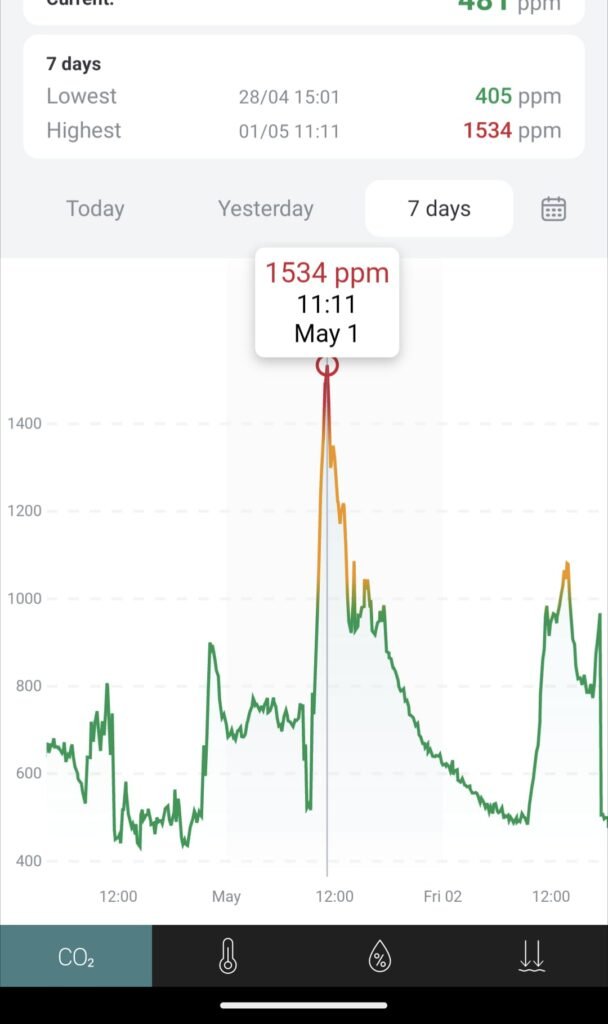
1534 ppm! That was just after two hours of work, at which point he stopped the test. He opened the door and brought the level down to 1200, which is still high enough to impact focus, performance, and can cause headaches in some people.
So most people have no idea!
That’s why I’ve started this blog – to help change that. Keeping your indoor CO₂ at a healthy level is simple and can lead to big improvements in how you feel and function. I will share some science behind this and some additional observations in new posts.
Meanwhile, have a good one and don’t forget to open your window!
Jan